
Retarder and superplasticizer are two of the most used concrete admixtures, and buyers often confuse them. Both improve workability, but they do it in completely different ways. One buys time. The other buys flow. This article explains the difference between retarder and superplasticizer in plain language: what each one does, how each one works, and when to use which.
The Short Answer
A retarder delays the setting time of concrete. It slows the early hydration reactions so the concrete stays workable for longer. A superplasticizer disperses cement particles and releases trapped water. It makes concrete flow better, and it lets you cut the water content by 15% to 30% without losing workability.
In one sentence: the retarder controls time, and the superplasticizer controls flow and water content. Now let us look at each one in detail.
What Does a Retarder Do?
A retarder is a chemical admixture that slows down cement hydration. Its molecules attach to cement particle surfaces and form a thin protective layer. They also bind free calcium ions in the mix. Both actions block the early reactions, so setting is delayed.
The practical effect is longer working time. Depending on the product and dosage, a retarder can extend the initial setting time by 2 to 5 hours. Special ultra-slow formulations can delay setting far longer. After the delay passes, hydration resumes and strength develops normally.
Common retarder chemistries include lignosulfonates, hydroxycarboxylic acids (such as citric acid and sodium gluconate), sugars and carbohydrates, and phosphates. Typical dosages are small, often 0.01% to 0.3% of the cement weight for the pure retarding chemicals. Retarders fall under ASTM C494 Type B (retarding) and Type D (water-reducing and retarding).
Engineers use retarders for hot-weather concreting, long transport hauls, and large continuous pours where cold joints must be avoided.
What Does a Superplasticizer Do?
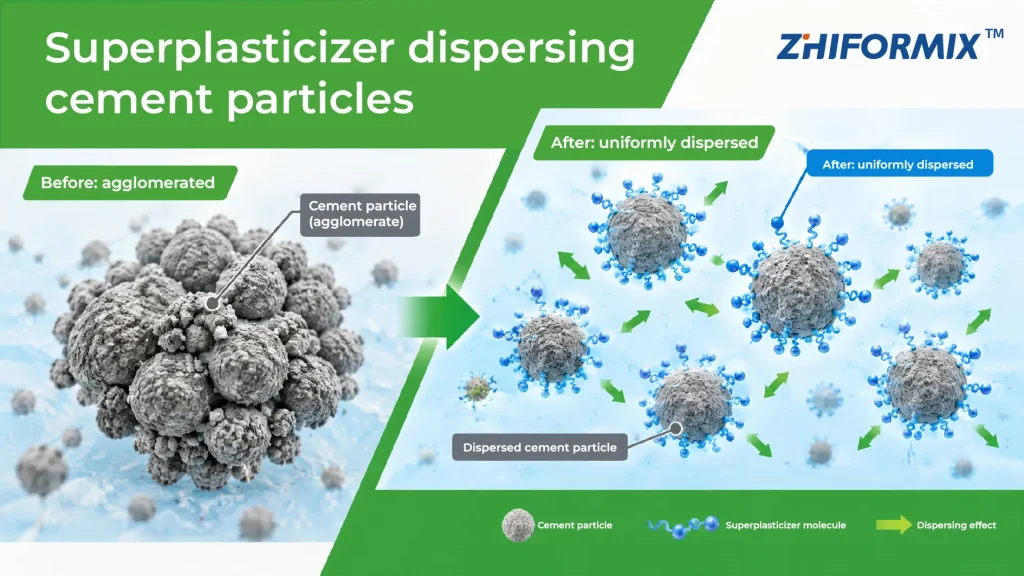
A superplasticizer is a high-range water reducer. Its molecules adsorb onto cement particles and break up the clumps through electrostatic repulsion and steric hindrance. Cement particles normally stick together in flocs that trap water inside. The superplasticizer disperses these flocs and frees the trapped water.
This gives you two powerful options. Option one: keep the same flow and cut the water content by 15% to 30%. Less water means a lower water-cement ratio, and that means higher strength and better durability. Option two: keep the same water content and get greatly enhanced flow. This produces flowing or self-leveling concrete for congested reinforcement and complex forms.
Common superplasticizer chemistries include sulfonated naphthalene formaldehyde (SNF), sulfonated melamine formaldehyde (SMF), and polycarboxylates (PCE). PCE is the newest generation and the most widely used today. Typical dosages run from about 0.25% to 1.2% of the cementitious materials. Superplasticizers fall under ASTM C494 Type F (high-range water-reducing) and Type G (high-range water-reducing and retarding).
Key Differences at a Glance
| Retarder | Superplasticizer | |
|---|---|---|
| Main purpose | Delay setting time, extend working time | Disperse particles, cut water or boost flow |
| Core mechanism | Protective film on cement particles, binds calcium ions | Electrostatic repulsion and steric hindrance disperse flocs |
| Main effect | Setting delayed by hours | Water cut by 15–30% at same flow, or much higher flow at same water |
| Effect on strength | No long-term strength loss | Increases strength through lower water-cement ratio |
| Typical dosage | 0.01–0.3% of cement weight | 0.25–1.2% of cementitious materials |
| ASTM C494 types | Type B, Type D | Type F, Type G |
| Main use cases | Hot weather, long hauls, large pours | High-strength concrete, precast, self-compacting concrete |
How Their Mechanisms Differ
The two admixtures attack different problems at the particle level.
A retarder is a chemical brake. It interferes directly with the hydration chemistry. By coating cement grains and tying up calcium ions, it slows the reactions that cause setting. The effect is on the clock. Everything happens later, but it still happens.
A superplasticizer is a physical dispersant. It does not try to stop hydration. Instead, it changes how particles arrange themselves in the fresh mix. Dispersed particles release their trapped water, so the mix flows with less added water. The effect is on the structure of the fresh paste, not on the reaction timeline.
This is why their side effects differ too. A retarder’s main risk is too much delay. A superplasticizer’s main risk is segregation, because a very fluid mix can separate if poorly designed.
Effects on Setting Time
Setting time is the retarder’s home territory. Delaying the set is its entire job, and the delay is strong and predictable.
Superplasticizers are more mixed. Older types like SNF and SMF have only a small effect on setting time. PCE superplasticizers often show a mild retarding effect of their own, because their molecules also adsorb on cement surfaces and slow early C3A hydration. This is usually a welcome bonus, not a problem.
When a project needs both high flow and long working time, the industry combines them. Type G admixtures pair high-range water reduction with retarded setting. Many ready-mix producers also compound a PCE superplasticizer with a separate retarding component. Compatibility matters here: some combinations adsorb competitively and reduce performance, so trial mixes are essential.
Effects on Concrete Strength
Here the difference is sharp.
A retarder does not change the water-cement ratio, so it does not change the strength potential. Long-term strength develops normally after the delay. Early strength may arrive a little later, but the design strength is safe.
A superplasticizer directly improves strength. By cutting water while keeping flow, it lowers the water-cement ratio. A lower ratio means denser hardened paste and higher compressive strength. This is why superplasticizers are standard in high-strength concrete, precast elements, and any project where durability matters.
When to Use Which
Choose based on your main problem.
Use a retarder when time is the problem. Hot weather concreting, long delivery hauls, traffic delays, and large pours that must stay continuous all call for a retarder. If the crew cannot finish before the mix stiffens, a retarder is the answer.
Use a superplasticizer when water or flow is the problem. High-strength concrete needs a low water-cement ratio without losing workability. Precast production needs fast mold filling. Congested reinforcement and complex forms need flowing, self-leveling mixes. These are superplasticizer jobs.
Use both when the project needs both. A hot-day pour of high-strength concrete is the classic case. The superplasticizer delivers the low water content and the flow, while the retarder protects the working window. Type G admixtures and careful compounding cover this combination.
Choosing Admixtures for Your Project
Start from the job conditions, not from the product catalog. Define what you need: more time, less water, more flow, or a combination. Share your mix design, cement type, and site temperatures with your admixture supplier. Then confirm everything with trial mixes using your real materials. Admixture behavior changes with cement chemistry, so a dose that works in one plant may behave differently in another.
Zhiwei (Jinan) New Materials Co., Ltd. supplies construction chemical additives to customers around the world. The company is known for its cellulose ethers and its gypsum retarder ZhiFormix™ GR-01, and it applies the same quality standards across its product lines. If your work involves gypsum-based materials, ZhiFormix™ GR-01 gives you adjustable setting time with dependable technical support. For concrete admixture questions, the Zhiwei team can point you in the right direction. Contact Zhiwei (Jinan) New Materials Co., Ltd. to discuss your application.
Frequently Asked Questions
What Is the Main Difference Between a Retarder and a Superplasticizer?
A retarder delays concrete setting time and extends working time. A superplasticizer disperses cement particles to reduce water content or increase flow. One controls time, the other controls water and flow.
Can a Superplasticizer Also Retard Setting?
Partly. PCE superplasticizers often have a mild retarding effect because their molecules adsorb on cement surfaces. But this effect is weaker and less predictable than a dedicated retarder. For real working-time control, use a proper retarder.
Can I Use a Retarder and a Superplasticizer Together?
Yes. This combination is common in practice. Type G admixtures combine both functions, and producers often compound a PCE superplasticizer with a retarding component. Always check compatibility with trial mixes first.
Which One Increases Concrete Strength?
The superplasticizer. By reducing the water-cement ratio at the same workability, it produces denser, stronger concrete. A retarder does not reduce water, so it does not increase strength. It simply delays setting without harming long-term strength.
Which Admixture Should I Use in Hot Weather?
A retarder is the first choice for hot weather, because heat shortens working time. If the mix also needs high strength or high flow, add a superplasticizer as well.
What Are Type B, D, F, and G Admixtures?
These are ASTM C494 classifications. Type B retards setting. Type D reduces water and retards setting. Type F is a high-range water reducer (superplasticizer). Type G combines high-range water reduction with retarded setting.
Conclusion
The difference between retarder and superplasticizer comes down to purpose and mechanism. A retarder is a chemical brake on hydration. It delays setting and buys working time for hot weather, long hauls, and large pours. A superplasticizer is a particle dispersant. It frees trapped water so you can cut the water-cement ratio for higher strength or get flowing concrete for difficult placements.
They are not competitors. They solve different problems, and they often work best together. Match the admixture to your project’s real constraint, confirm the dosage with trial mixes, and you will get the performance you specified.